
Lab Created Diamond Earrings What Matters Beyond Carat Size
Two diamond earrings can share the same total carat weight yet look noticeably different on the ear. The difference may come from cut quality, stone dimensions, setting height, metal choice, or how evenly the pair has been matched. This makes carat weight useful, but rarely sufficient on its own.
For shoppers considering lab created diamond earrings, the practical question is not simply how large the diamonds are. It is how the stones, setting and construction work together. Earrings sit close to the face, move with the wearer and are often viewed from several angles, so details that seem minor on a specification sheet can affect their appearance and comfort.
Start With the Pair, Not Two Individual Diamonds
Diamond earrings create a matching challenge that does not apply in quite the same way to a solitaire engagement ring. Each stone may be attractive individually, yet the pair can still look uneven if their visible dimensions or colour differ.
For round diamond studs, compare millimetre measurements as well as carat weight. Two stones of similar weight can have slightly different diameters because weight is distributed through the stone’s proportions.
Matching colour grades is sensible, although extremely high grades are not automatically necessary for every pair. Metal can influence perception too. White gold or platinum creates a bright surrounding, while yellow or rose gold introduces warmer contrast.
Clarity deserves a similarly practical approach. Earrings are usually viewed from farther away than rings, so paying a premium for a very high clarity grade may offer little visible advantage if lower-graded stones are eye-clean.
Cut Has an Outsized Effect on Stud Earrings
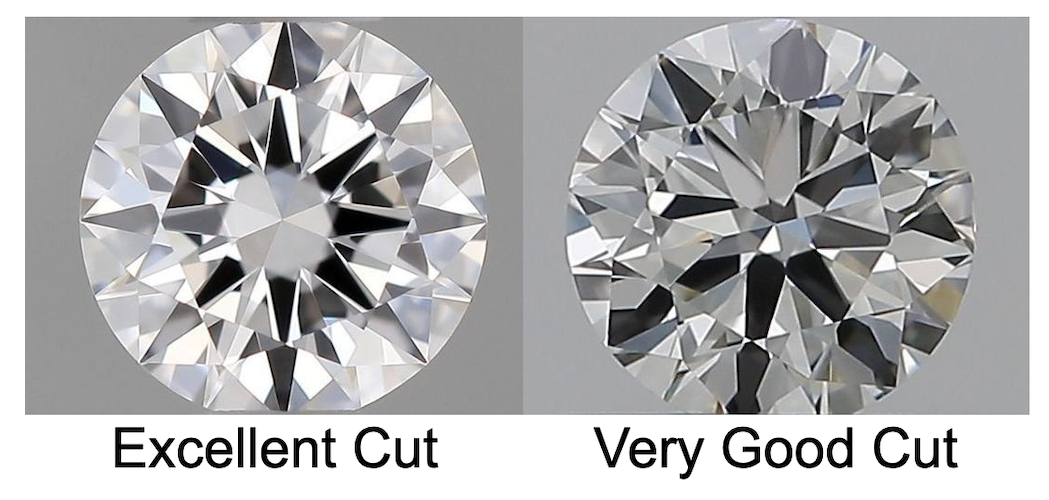
A pair of studs presents diamonds face-up, making light performance particularly noticeable. For round brilliants, cut quality deserves serious attention because it affects brightness, contrast and sparkle.
A larger stone with weak proportions may appear less lively than a slightly smaller diamond with stronger cutting. Buyers working within a fixed budget may therefore prefer to protect cut quality before increasing carat weight.
Fancy shapes require a different assessment. Oval, pear, emerald and cushion cuts do not all behave like round brilliants. Look at their outline, symmetry and visible light patterns rather than assuming a grading term tells the entire story.
With elongated shapes, matching length-to-width ratios can help the earrings look balanced. For step cuts such as emerald cuts, clarity can become more noticeable because the broad facets may make inclusions easier to see.
The Setting Changes How the Diamond Looks and Feels
The setting is easy to treat as decoration, but it affects security, profile and daily comfort.
Four-prong settings expose much of a round stone and can create a relatively open appearance. Bezel settings surround the diamond with metal, offering more edge protection but changing the visual outline. Halo designs add smaller stones around the centre and create a different scale on the ear.
Basket depth also matters. A setting that projects farther from the ear may tilt forward, especially with larger stones. A lower-profile construction can sit closer to the lobe, although the exact result depends on the earring design and the wearer’s piercing position.
For lab created diamond earrings intended for frequent use, inspect the back and post as carefully as the front. The earring should feel secure without creating unnecessary pressure.
| Detail | What to Check | Why It Matters |
|---|---|---|
| Cut | Proportions and light performance | Influences brightness and visual presence |
| Measurements | Face-up dimensions in millimetres | Helps determine apparent size |
| Pair matching | Size, colour and overall appearance | Keeps the earrings visually balanced |
| Setting | Prongs, bezel, basket and profile | Affects security and how the stone sits |
| Backing | Fit and fastening method | Influences comfort and loss risk |
| Grading | Report details and stone identification | Helps verify stated diamond characteristics |
Certification Is Useful, but Read the Report Properly
Independent grading documentation can help buyers understand what they are paying for. A grading report may identify the diamond as laboratory-grown and record characteristics such as carat weight, colour and clarity, with additional information depending on the laboratory and report type.
A report should be treated as technical information rather than a substitute for viewing the finished earrings. Two diamonds with similar grades can still show differences in their dimensions and visual character.
Consumers researching lab created diamonds can use grading information alongside photographs, videos and setting specifications to compare stones rather than relying on carat weight alone.
Before ordering, confirm whether both centre stones have individual grading reports when applicable, and check that the documentation corresponds to the diamonds being supplied.
Think in Millimetres Before Increasing Carat Weight
Carat measures weight, not visible diameter. This distinction becomes particularly useful with earrings because buyers often want to know how much of the earlobe the stones will cover.
Instead of asking only for a one-carat or two-carat pair, compare the face-up measurements of each stone. The dimensions can provide a clearer idea of physical scale.
Remember that earring carat weights are also frequently described as total carat weight for the pair. If a listing gives a combined figure, confirm how that weight is divided between the two centre stones.
This small clarification prevents a common misunderstanding during online purchase research.
Metal Choice Should Account for Wear, Maintenance and Appearance
Platinum and gold are established fine-jewellery metals, but the right choice depends on the design and wearer.
White gold provides a bright appearance around colourless or near-colourless stones, although some white-gold jewellery may require maintenance of its surface finish over time. Yellow and rose gold provide visible contrast and may suit buyers who want the metal to form part of the design rather than visually recede.
Platinum has its own wear characteristics and density. For earrings, overall weight and construction should be considered alongside appearance, particularly for larger designs.
Singapore buyers ordering online should check the stated metal type and purity, earring dimensions, backing style, return terms and any available resizing or modification policies before payment.
Decide Where the Budget Will Be Visible
The strongest specification sheet is not necessarily the strongest pair of earrings. Spending more on a clarity improvement that cannot be seen without magnification may be less useful than choosing better-matched stones or a more suitable setting.
For classic lab created diamond earrings, a sensible comparison starts with cut and visible dimensions, then examines pair matching, colour, eye-visible clarity and setting construction. Buyers interested in larger stones can then increase carat weight without losing sight of those fundamentals.
The final check should happen at the level of the finished jewellery. Ask for the measurements of both diamonds, confirm whether carat weight is stated per stone or for the pair, identify the grading documentation supplied, and inspect how the setting holds each stone. Those details reveal far more about everyday wear than carat weight alone.